Journalism
Turn your curiosity into a career as a factual storyteller who serves our communities.
- Learn transferable media skills by studying alongside Radio and TV Broadcasting students
- Produce and showcase your work in The Algonquin Times, our award winning campus paper
- Gain hands-on experience and expand your portfolio almost immediately upon starting the program
Program Availability and Schedule
Availability
Open
Closed
Waitlisted
Start Term
Availability
International
Availability
Competitive?
Fall 2024
No
Winter 2025
No
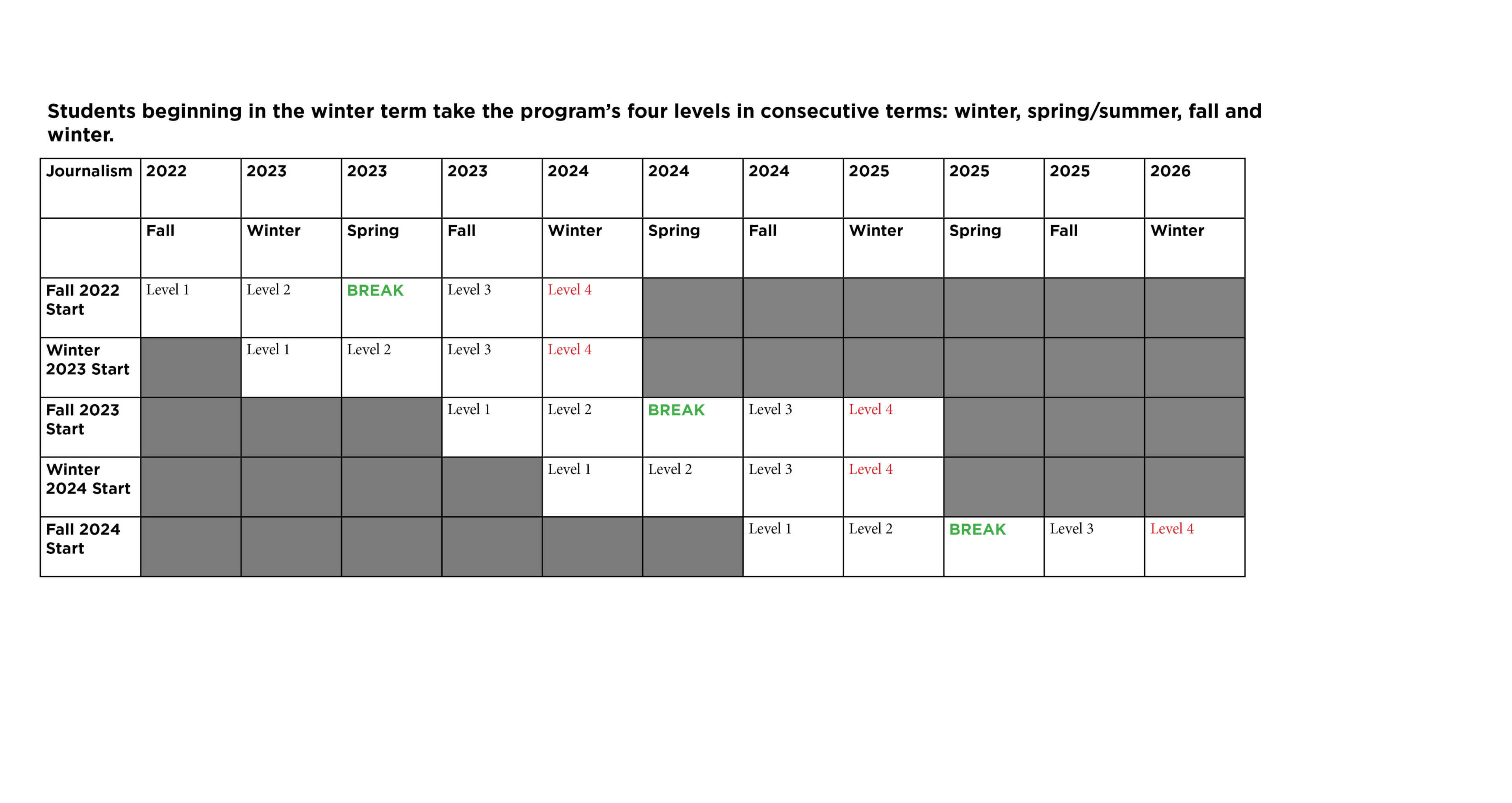
Schedule
Program Summary
Credential
Program Delivery
Program Code
Area of Interest
School
Campus
Work Integrated Learning
The two-year Journalism Ontario College Diploma program equips you with the versatile creative and technical skills you need to report and research accurate stories for readers, listeners and viewers. Alongside experienced, industry-connected faculty, you develop the core journalistic skills required to report on your areas of interest. These may include people, current affairs or specialized sectors like sports, the environment, social justice, entertainment or gaming.
As a student, you become a staff member with the Algonquin Times, our award-winning campus newspaper, and Glue magazine, our Ottawa-wide student publication. Here, you develop hands-on skills:...(read more)
Overview
Turn your curiosity into a career as a factual storyteller who serves our communities.
The two-year Journalism Ontario College Diploma program equips you with the versatile creative and technical skills you need to report and research accurate stories for readers, listeners and viewers. Alongside experienced, industry-connected faculty, you develop the core journalistic skills required to report on your areas of interest. These may include people, current affairs or specialized sectors like sports, the environment, social justice, entertainment or gaming.
As a student, you become a staff member with the Algonquin Times, our award-winning campus newspaper, and Glue magazine, our Ottawa-wide student publication. Here, you develop hands-on skills:
- finding and pitching story ideas
- using research strategies
- interviewing
- seeking and locating diverse, knowledgeable sources
- writing
- editing
- taking photos
- shooting video
- recording and editing audio
- using analytics
- producing social media content
- working with content management systems
- understanding media ethics and law
In the first level of the program, you study alongside Broadcasting - Television and Broadcasting - Radio students, building a strong foundation in transferable media skills while exploring these related fields. In the second year, you will have the opportunity to choose a specialty elective course that aligns with your media interests. In this program, you are given the opportunity to work on interprofessional teams with other media programs. You also put theory to work through collaborations with real-world media partners. In the final term of the program, you take part in a six-week field placement with a media or communications host.
Journalism skills are in demand and portable to many different career options after graduation. Graduates may find work in government, private-sector or not-for-profit sectors. You may find employment in the following environments:
- community news outlets
- radio or television newsrooms
- social media departments or businesses
- communications departments or businesses
- specialty content outlets
- visual storytelling teams
- podcasting production outlets
- research departments
Opportunities may also exist for you to work as a freelancer or to start your own independent news outlet or brand.
SUCCESS FACTORS
This program is well-suited for students who:
- Are keen to serve the community through fair and accurate storytelling.
- Are willing to learn to interact with a wide variety of people.
- Possess a keen curiosity about news happening locally, nationally and globally.
- Have solid writing and listening skills.
- Enjoy reading and following news and current events.
Courses
Programs at Algonquin College are delivered using a variety of instruction modes. Courses may be offered in the classroom or lab, entirely online, or in a hybrid mode which combines classroom sessions with virtual learning activities. Upon registration, each full-time student is provided an Algonquin email account which is used to communicate important information about program or course events.
Code:
ENL1813M
Course Name:
Communications I
Course Description:
Communication remains an essential skill sought by employers, regardless of discipline or field of study. Using a practical, vocation-orient... + Read More
Hours:
42.0
Code:
JOU0001
Course Name:
Storytelling Fundamentals
Course Description:
In order to be factual storytellers who serve communities, journalists need to become familiar with core journalism concepts including what ... + Read More
Hours:
42.0
Code:
JOU0002
Course Name:
News Writing
Course Description:
News readers rely on journalists to deliver news and information in a clear, succinct and readable way. Students write leads, structure basi... + Read More
Hours:
56.0
Code:
JOU0003
Course Name:
Media Law and Ethics
Course Description:
Journalists play an essential role in a functioning Canadian democracy, providing accurate and objective stories that Canadians can trust. S... + Read More
Hours:
28.0
Code:
PHO0011
Course Name:
Introduction to Photography
Course Description:
Photography is a powerful visual communication tool that can be used to enhance storytelling. Students discover the capabilities of DSLR cam... + Read More
Hours:
42.0
Code:
SSC0058
Course Name:
Local Government
Course Description:
Whether we're taking the bus, playing hockey at the local arena, taking out the trash or simply living in an apartment or house, municipal g... + Read More
Hours:
42.0
Code:
TVA0010
Course Name:
Exploring Image and Sound
Course Description:
In order to produce high quality audio and video assets, media industry professionals must understand the fundamentals of image, sound, and ... + Read More
Hours:
56.0
Code:
ENL2008
Course Name:
Interpersonal Skills for Personal and Career Success
Course Description:
To be effective storytellers, writers need to work with others. Students explore several different factors that affect our relationships, in... + Read More
Hours:
42.0
Code:
JOU0004
Course Name:
Editing for the Digital Environment
Course Description:
Self-editors today need to ensure their copy is clean and accurate - and that they apply digital strategies to help deliver it to their read... + Read More
Hours:
28.0
Code:
JOU0005
Course Name:
Newsroom 1
Course Description:
The best way to learn about journalism is to practise it. Students apply news reporting theories as they work as reporters and editors with ... + Read More
Hours:
56.0
Code:
JOU0006
Course Name:
Journalism Techniques
Course Description:
Reporters and editors require a strong foundation in ethics, laws and professional practises of their journalistic craft. Beats such as cour... + Read More
Hours:
28.0
Code:
JOU0007
Course Name:
Audio Storytelling
Course Description:
Telling stories for the ear is as important as doing it for the eye. Building on basic audio skills, students begin to explore the journalis... + Read More
Hours:
28.0
Code:
JOU0008
Course Name:
Photojournalism
Course Description:
Photography and video are essential partners for every news story. Using foundational photography skills, reporters must learn how to think ... + Read More
Hours:
42.0
Code:
JOU1524
Course Name:
Narrative Storytelling
Course Description:
Readers, listeners and viewers love to be told true, factual stories. Narrative storytelling techniques help journalists do just this. By st... + Read More
Hours:
42.0
Code:
GED0402
Course Name:
General Education Elective
Course Description:
Students choose one course, from a group of general education electives, which meets one of the following five theme requirements: Arts in S... + Read More
Hours:
42.0
Code:
JOU0009
Course Name:
Newsroom 2
Course Description:
With core reporting skills in place, new journalists are ready to further their interviewing, researching and reporting abilities using adva... + Read More
Hours:
56.0
Code:
JOU0010
Course Name:
Story Lab 1
Course Description:
Journalists and editors rely on technical tools to tell stories visually and graphically as stand-alone items, companions for written or aud... + Read More
Hours:
42.0
Code:
JOU0011
Course Name:
Television News
Course Description:
A multiskilled journalist needs to understand how to write and produce for television and streaming brands. Students gain experience with al... + Read More
Hours:
28.0
Code:
JOU1537
Course Name:
Editing for Story
Course Description:
A substantive editor needs to understand what an audience needs and how to work with a writer and their copy to serve those needs. Students ... + Read More
Hours:
42.0
Code:
RAD1569
Course Name:
Podcasting
Course Description:
Subscribers are looking for podcasting content that they can consume when and where they want it. Many brands, companies and individuals are... + Read More
Hours:
42.0
Code:
COM0017
Course Name:
Engaging Through Social Media
Course Description:
Social media platforms and strategies play a key role in how media brands engage with their audience. Students evaluate social media campaig... + Read More
Hours:
42.0
Code:
JOU0012
Course Name:
Solutions Journalism
Course Description:
Solutions journalism improves communities through positive, insightful news that turns the negative reputation of news on its head. Its goal... + Read More
Hours:
42.0
Code:
TVA0017
Course Name:
Esports Production
Course Description:
As the gaming industry continues to integrate into popular culture as well as the streaming and broadcast industries, producers and technici... + Read More
Hours:
42.0
Code:
GED0402
Course Name:
General Education Elective
Course Description:
Students choose one course, from a group of general education electives, which meets one of the following five theme requirements: Arts in S... + Read More
Hours:
42.0
Code:
JOU0013
Course Name:
Trends in Journalism
Course Description:
With the rapid rate of innovation in journalism and media communications, keeping pace with the latest developments, emerging sectors and is... + Read More
Hours:
14.0
Code:
JOU0014
Course Name:
Freelancing and Independent Publishing
Course Description:
The ability for a journalist or non-fiction storyteller to work for themselves as a freelance contractor or as an independent publisher is a... + Read More
Hours:
28.0
Code:
JOU0015
Course Name:
Business Journalism
Course Description:
Understanding the essentials of business reporting is a necessary skill in a wide range of roles and sectors. For instance, journalists need... + Read More
Hours:
14.0
Code:
JOU0016
Course Name:
Radio News
Course Description:
Reporting and writing for radio are skills flexible journalists and storytellers require. Students explore and practise broadcast news style... + Read More
Hours:
28.0
Code:
JOU0017
Course Name:
Story Lab 2
Course Description:
Dynamic multimedia stories require dedicated time and collaboration from digital storytellers with foundational technical and journalistic s... + Read More
Hours:
28.0
Code:
JOU1549
Course Name:
Journalism for Communications
Course Description:
Journalism skills are versatile and can be applied across a wide variety sectors where storytelling, synthesis, and clear communication are ... + Read More
Hours:
14.0
Code:
JOU1554
Course Name:
Field Placement
Course Description:
Putting new journalism and communications skills to practise and receiving professional mentorship supports graduates when entering industry... + Read More
Hours:
180.0
Code:
LFS0018
Course Name:
Career Development
Course Description:
New professionals must understand today's evolving media landscape and how to showcase the desired knowledge and skills to prospective emplo... + Read More
Hours:
28.0
Careers & Pathways
Careers
Graduates may find employment as multi-skilled journalists, reporters, communications specialists, branded content storytellers, radio broadcasters, chase producers, content writers, researchers, photographers, videographers, social media specialists. Opportunities may also exist for graduates wishing to freelance.
Pathways
Please note: There may be more pathways available for this program than are listed here. Please use our Pathways search tool to see every option.
Learning Outcomes
The graduate has reliably demonstrated the ability to:
- Report on stories in an accurate, detailed, balanced, professional, and timely manner.
- Apply computer and technical skills to designated production and research functions in journalism.
- Function both independently and as a member of editorial and/or production teams.
- Analyze knowledge from communities, current events and public affairs, and history to interpret and express the context for designated journalism publications and/or productions.
- Develop strategies for personal and professional development.
- Comply with relevant Canadian legislation, standards, and the principles and practices of journalism.
- Write and edit content for the designated media platforms.
- Publish and/or broadcast content for the designated media platforms.
- Apply production skills and use production equipment in the preparation and distribution of content for the designated media platforms.
- Identify and apply discipline-specific practices that contribute to the local and global community through social responsibility, economic commitment and environmental stewardship.
Tuition & Fees
Get an idea of how much each semester will cost with our Tuition and Fee Estimator.
2023/2024 Academic Year
Tuition and related ancillary fees for this program can be viewed by using the Tuition and Fees Estimator tool at www.algonquincollege.com/fee-estimator.
Further information on fees can be found by visiting the Registrar`s Office website at www.algonquincollege.com/ro.
Fees are subject to change.
Additional program related expenses include:
- Books and supplies cost approximately $200 in the first year and $100 in the second year.
- A Nikon digital SLR camera with video capability and an external microphone input (approx. $1,000) is required in the first level. Students should wait to purchase a camera until up-to-date specifications are provided by the program faculty.
- A smartphone with HD resolution to shoot video, photos and send email is required.
- Software specific to course needs will be provided by the college.
Admissions Requirements
All applicants must satisfy both College Eligibility and Program Eligibility requirements.
College Eligibility
- Ontario Secondary School Diploma (OSSD) or equivalent. Applicants with an OSSD showing senior English and/or Mathematics courses at the Basic Level, or with Workplace or Open courses, will be tested to determine their eligibility for admission; OR
- Academic and Career Entrance (ACE) certificate; OR
- General Educational Development (GED) certificate; OR
- Mature Student status (19 years of age or older and without a high school diploma at the start of the program). Eligibility may be determined by academic achievement testing for which a fee of $50 (subject to change) will be charged.
Program Eligibility
- English, Grade 12 (ENG4C or equivalent) with a grade of 70% or higher.
- Applicants with international transcripts must provide proof of the subject-specific requirements noted above and may be required to provide proof of language proficiency. Domestic applicants with international transcripts must be evaluated through the International Credential Assessment Service of Canada (ICAS) or World Education Services (WES).
- IELTS-International English Language Testing Service (Academic) Overall band of 6.5 with a minimum of 6.0 in each band; OR TOEFL-Internet-based (iBT) Overall 88, with a minimum of 22 in each component: Reading 22; Listening 22; Speaking 22; Writing 22; OR Duolingo English Test (DET) Overall 120, minimum of 120 in Literacy and no score below 105.
- Not sure if you meet all of the requirements? Academic Upgrading may be able to help with that: https://www.algonquincollege.com/access/.
Application Information
JOURNALISM
Program Code 0402X01FWO
Applications to full-time day programs must be submitted with official transcripts showing completion of the academic admission requirements through:
ontariocolleges.ca
60 Corporate Court
Guelph, Ontario N1G 5J3
1-888-892-2228
Applications are available online www.ontariocolleges.ca.
Applications for Fall Term and Winter Term admission received by February 1 will be given equal consideration. Applications received after February 1 will be processed on a first-come, first-served basis as long as places are available.
International applicants applying from out-of-country can obtain the International Student Application Form at https://algonquincollege.force.com/myACint/ or by contacting the Registrar`s Office.
For further information on the admissions process, contact:
Registrar`s Office
Algonquin College
1385 Woodroffe Ave
Ottawa, ON K2G 1V8
Telephone: 613-727-0002
Toll-free: 1-800-565-4723
TTY: 613-727-7766
Fax: 613-727-7632
Contact: https://www.algonquincollege.com/ro
Additional Information
Program Resources
This program has a field work component that must be completed in order to graduate. Finding and securing an approved field work opportunity is a shared responsibility. Your faculty and field work supervisor/coordinator have contacts in industry and where feasible will assist you in finding an approved field placement.
The Journalism faculty members and students collaborate in spaces that respect diversity, honour inclusivity and support equity. This includes acknowledging systemic issues related to marginalized groups, including those represented by gender, race, age, religion, physical disabilities, sexual orientation, neurodiversity, and socioeconomic status.
Contact
Julie McCann
Program Coordinator

Julie has been a full-time journalism professor at Algonquin College since 2003. Prior to that, she was a staff writer at National Post Business magazine and a contributor to Chatelaine, Canadian Geographic, Applied Arts, the Montreal Gazette and the Ottawa Citizen. Previously she was the managing editor Canadian in-flight magazine and a staff writer at Marketing Magazine. She holds a B.A.A. in journalism (magazine) from Ryerson University and an M.J. from Carleton University. She makes her home in Ottawa.
Jon Willing
Program Coordinator
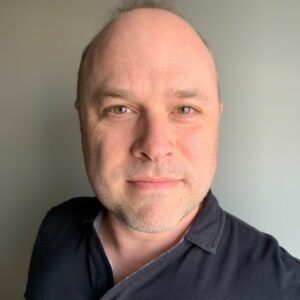
Jon joined Algonquin College as a full-time journalism professor in August 2022. He previously taught local government to journalism students during the fall semesters as he worked as a municipal government beat reporter for the Ottawa Citizen and Ottawa Sun. Before reporting on city hall for 13 years, Jon covered the Ottawa-area crime beat for the Sun. He has also provided news commentary for radio and TV shows. Jon holds a Bachelor of Arts degree in English Rhetoric and Professional Writing from the University of Waterloo and a Master of Arts degree in Journalism from Western University. He lives in Ottawa.
Ralph Plath
Professor
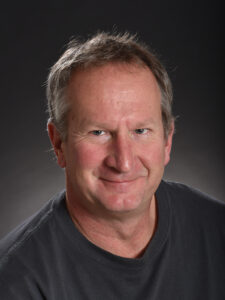
Ralph Plath graduated from the Algonquin College Journalism program in 1992 and has worked as a staff reporter, photographer, and editor for various newspapers across Canada, including the Pembroke Observer and the Yellowknifer, as well as being part-owner of a Sports and Entertainment newspaper in Ottawa.
He has been a part-time instructor with the Journalism program since 2000 while working as a freelance editorial, PR, and wedding photographer, as well as a travel writer. His freelance work has appeared in such publications as the Ottawa Citizen, Globe and Mail, Canoe and Kayak Magazine, Paddler Magazine, Kanawa Magazine, and Comment Magazine.
Jessica Brando
Professor
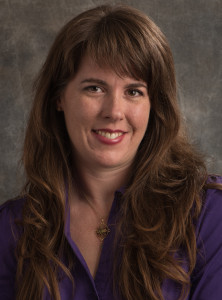
Great journalists have a number of skills, including knowing how to tell a story for the ear. Jessica built a career doing that, first with CBC Radio, and more recently as a podcast producer. She’s a full-time professor with the Broadcasting, Radio and Podcasting program, but moonlights in the Journalism program, teaching Audio Storytelling, Podcasting and Radio News classes.
Jessica hopes her classes get students excited to record interviews, edit audio and produce live radio on the campus station, CKDJ. When she’s not in the classroom, you’ll likely find her being a mom to her two teens, and doting on her pandemic-pet, Sophie the Cat.
Patrick Smith
Professor
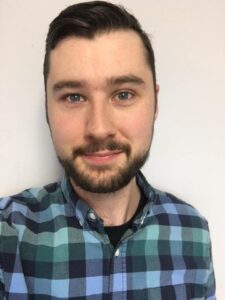
Patrick has been teaching in the Journalism program at Algonquin College since 2016, prior to which he wrote for the Ottawa Citizen and reported on Parliament Hill with Postmedia News. He also currently works in communications at the Canada Safety Council. He holds a diploma in journalism and a certificate in Interactive Media Management from Algonquin College, along with a B.A. in Political Science from Carleton University. Patrick resides in Carleton Place.