Computer Systems Technician (Co-op and Non Co-op Version)
Turn your technical skills into a career supporting today`s advancing IT solutions.
- Enjoy a more personalized learning environment with our small classes
- Benefit from supportive and experienced faculty who are active in their industry
- Gain the latest and best industry-specific knowledge and skills to be career-ready upon graduation
Program Availability and Schedule
Availability
Open
Closed
Waitlisted
Start Term
Availability
International
Availability
Competitive?
Fall 2024
No
Schedule
Program Summary
Credential
Program Delivery
Program Code
Area of Interest
School
Campus
Work Integrated Learning
This two-year Ontario College Diploma program, delivered in a compressed format over 42 weeks, provides you with the technical knowledge and expertise to support the use of computers and networks. You also develop your communication and administration skills, including the ability to work in teams and use project management and customer service techniques.
Focus on the technical aspects of commonly used components and troubleshooting techniques for computer hardware, operating systems, networking technologies, system administration, and a suite of related support and application software packages. Gain requirements and subject matter knowledge found in certifications such as:...(read more)
Overview
Turn your technical skills into a career supporting today`s advancing IT solutions.
This two-year Ontario College Diploma program, delivered in a compressed format over 42 weeks, provides you with the technical knowledge and expertise to support the use of computers and networks. You also develop your communication and administration skills, including the ability to work in teams and use project management and customer service techniques.
Focus on the technical aspects of commonly used components and troubleshooting techniques for computer hardware, operating systems, networking technologies, system administration, and a suite of related support and application software packages. Gain requirements and subject matter knowledge found in certifications such as:
- Computer Technology Industry Association (CompTIA) A+
- Network+
- Linux+
- Security+
Some courses fulfill part of the basic requirements of Microsoft Technology Associate (MTA) and Microsoft Certified Technology Specialist (MCTS) certifications.
Students also have the option to gain real-world experience through a paid co-operative education (co-op) work term (see Additional Information for more details). Please note that places in the co-op work term are subject to availability and academic eligibility. Please note admission to the co-op program does not guarantee a co-op placement.
Graduates are able to work individually or as part of a team to implement and maintain information technology (IT) solutions that correspond to the day-to-day requirements of individuals and organizations. From repairing desktop computers to network administration, graduates work in a broad range of employment settings in a variety of sectors, in both large and small organizations.
SUCCESS FACTORS
This program is well-suited for students who:
- Are interested in learning how to implement and troubleshoot computer technology, operating systems and networking technology solutions.
- Enjoy the challenge of a constantly evolving field.
- Can work independently or in a team environment.
- Have good problem-solving and analytical skills.
Courses
Programs at Algonquin College are delivered using a variety of instruction modes. Courses may be offered in the classroom or lab, entirely online, or in a hybrid mode which combines classroom sessions with virtual learning activities. Upon registration, each full-time student is provided an Algonquin email account which is used to communicate important information about program or course events.
Code:
CST7205
Course Name:
PC Systems Technology
Course Description:
Computer technology is built upon hardware, which requires regular maintenance as well as periodic upgrading and repair. Students work with ... + Read More
Hours:
56.0
Code:
CST7206
Course Name:
Networking Fundamentals
Course Description:
The modern world is connected, and networking technologies form the foundation of data communication. Students describe the architecture, to... + Read More
Hours:
70.0
Code:
CST7207
Course Name:
GNU/Linux System Support
Course Description:
GNU/Linux is an open source operating system that operates on a variety of computing devices such as mobile devices, server systems and supe... + Read More
Hours:
70.0
Code:
CST7210
Course Name:
Windows Desktop Support
Course Description:
MS Windows desktop is a commonly implemented desktop operating system in industry. Students prepare a MS Windows client system for participa... + Read More
Hours:
56.0
Code:
ENL7777
Course Name:
Communications I
Course Description:
Communication remains an essential skill sought by employers, regardless of discipline or field of study. Using a practical, vocation-orient... + Read More
Hours:
42.0
Code:
GEP1001
Course Name:
Cooperative Education and Job Readiness
Course Description:
Students are guided through a series of activities that prepare them to conduct a professional job search and succeed in the workplace. Thro... + Read More
Hours:
18.0
Code:
MAT7401
Course Name:
Numeracy and Logic
Course Description:
Computer systems technicians are required to work with number systems used in computer technology. Students perform conversions and mathemat... + Read More
Hours:
42.0
Code:
PRL7532
Course Name:
College and Career Success
Course Description:
Students develop and expand their abilities as lifelong learners. These abilities are essential to students as they take their place in coll... + Read More
Hours:
42.0
Code:
CST7220
Course Name:
PC Troubleshooting
Course Description:
A problem-solving methodology is the foundation for effectively troubleshooting computing problems to support IT infrastructures. Students d... + Read More
Hours:
56.0
Code:
CST7223
Course Name:
Foundation of IT Service Management
Course Description:
Technical customer support is an essential business service, and knowledge of IT Service Management, as described in the IT Infrastructure L... + Read More
Hours:
42.0
Code:
CST7224
Course Name:
Windows Domain Administration
Course Description:
MS Windows Server is an enterprise-level operating system that supports the computing requirements of a modern business. Students manage an ... + Read More
Hours:
70.0
Code:
CST7270
Course Name:
Routing and Switching Fundamentals
Course Description:
A fundamental concept of networking is to connect network segments. Students implement switched networks based on industry standard design a... + Read More
Hours:
70.0
Code:
CST7277
Course Name:
GNU/Linux Server Administration
Course Description:
The GNU/Linux operating system, known for its flexibility and stability, is implemented as a server solution in a variety of business establ... + Read More
Hours:
56.0
Code:
ENL7618
Course Name:
Technical Communication - Computer Systems Technician
Course Description:
Students achieve graduate level communication skills that computer systems technicians require in order to be successful in the workplace. T... + Read More
Hours:
42.0
Code:
GED1150
Course Name:
General Education Elective
Course Description:
Students choose one course, from a group of general education electives, which meets one of the following four theme requirements: Arts in S... + Read More
Hours:
42.0
Code:
WKT7102
Course Name:
Cooperative Education Work Term
Course Description:
For students who qualify academically and who choose to participate, there is the opportunity to enhance their diploma with an officially re... + Read More
Hours:
Code:
CST7230
Course Name:
Network Security
Course Description:
The objective of network security is to maintain access to network resources for legitimate users and is an integral part of network adminis... + Read More
Hours:
70.0
Code:
CST7234
Course Name:
Database Management and Interfacing
Course Description:
Data as a business asset requires the implementation of data storage and management technologies. Students explain the theoretical concepts ... + Read More
Hours:
56.0
Code:
CST7236
Course Name:
Network Services Administration
Course Description:
The client-server model, an essential part of network computing, enables client systems to use services, such as email or web services, over... + Read More
Hours:
56.0
Code:
CST7237
Course Name:
Windows Enterprise Administration
Course Description:
Modern enterprise-level IT solutions include on-site network service administration, as well as cloud integration. To optimize the managemen... + Read More
Hours:
70.0
Code:
CST7238
Course Name:
Technical Project
Course Description:
Computer Systems Technicians support a variety of projects within an organization. Students participate as team members in the planning, sch... + Read More
Hours:
14.0
Code:
CST7272
Course Name:
Introduction to Enterprise Networking
Course Description:
Network scalability features are an integral part of Enterprise network administration. Students configure dynamic routing protocols, develo... + Read More
Hours:
70.0
Code:
GED1150
Course Name:
General Education Elective
Course Description:
Students choose one course, from a group of general education electives, which meets one of the following four theme requirements: Arts in S... + Read More
Hours:
42.0
Careers & Pathways
Careers
Graduates may find employment as technical support specialists for PCs and Networks in a wide variety of corporate environments in the industrial, governmental and service sectors. Positions may also include system administration and maintenance for LAN/WAN (Local Area Network/Wide Area Network), Internet/Intranet and Unix/Linux environments, hardware/software sales representatives, customer service support representatives, technical support specialists, network installation and implementation specialists.
Pathways
Please use our Pathways tool to search for pathway options.
Learning Outcomes
The graduate has reliably demonstrated the ability to:
- Identify, analyze, develop, implement, verify and document the requirements for a computing environment.
- Contribute to the diagnostics, troubleshooting, documenting and monitoring of technical problems using appropriate methodologies and tools.
- Implement and maintain secure computing environments.
- Implement robust computing system solutions through validation testing that aligns with industry best practices.
- Communicate and collaborate with team members and stakeholders to ensure effective working relationships.
- Select and apply strategies for personal and professional development to enhance work performance.
- Apply project management principles and tools when working on projects within a computing environment.
- Adhere to ethical, legal, and regulatory requirements and/or principles in the development and management of computing solutions and systems.
- Assist with the implementation of computer systems and cloud solutions.
- Install, configure, troubleshoot, maintain, upgrade and decommission computing system infrastructures.
- Automate routine tasks using scripting tools and programming languages.
- Install and monitor a database management system in response to specified requirements.
- Provide technical support for computing system infrastructures that aligns with industry best practice.
- Identify and apply discipline-specific practices that contribute to the local and global community through social responsibility, economic commitment and environmental stewardship.
Tuition & Fees
Get an idea of how much each semester will cost with our Tuition and Fee Estimator.
2023/2024 Academic Year
Tuition and related ancillary fees for this program can be viewed by using the Tuition and Fees Estimator tool at www.algonquincollege.com/fee-estimator.
Further information on fees can be found by visiting the Registrar`s Office website at www.algonquincollege.com/ro.
Fees are subject to change.
Additional program related expenses include:
- eTextbooks: As a student in a program that has adopted a combination of hardcopy and digital resources, your required textbooks may be purchased at the campus bookstore, or available as digital resources.
- Books and supplies cost approximately $400 - $500 per term.
- In addition, students should expect to spend between $80 - $100 for the tools necessary in the labs.
Admissions Requirements
All applicants must satisfy both College Eligibility and Program Eligibility requirements.
College Eligibility
- Ontario Secondary School Diploma (OSSD) or equivalent. Applicants with an OSSD showing senior English and/or Mathematics courses at the Basic Level, or with Workplace or Open courses, will be tested to determine their eligibility for admission; OR
- Academic and Career Entrance (ACE) certificate; OR
- General Educational Development (GED) certificate; OR
- Mature Student status (19 years of age or older and without a high school diploma at the start of the program). Eligibility may be determined by academic achievement testing for which a fee of $50 (subject to change) will be charged.
Program Eligibility
- English, Grade 12 (ENG4C or equivalent).
- Mathematics, Grade 12 (MAP4C or equivalent).
- Applicants with international transcripts must provide proof of the subject-specific requirements noted above and may be required to provide proof of language proficiency. Domestic applicants with international transcripts must be evaluated through the International Credential Assessment Service of Canada (ICAS) or World Education Services (WES).
- IELTS-International English Language Testing Service (Academic) Overall band of 6.0 with a minimum of 5.5 in each band; OR TOEFL-Internet-based (iBT) Overall 80, with a minimum of 20 in each component: Reading 20; Listening 20; Speaking 20; Writing 20;OR Duolingo English Test (DET) Overall 110, minimum of 110 in Literacy and no score below 95.
Should the number of qualified applicants exceed the number of available places, applicants will be selected on the basis of their proficiency in English and mathematics.
Note: Applicants are encouraged to acquire basic computer skills such as keyboard proficiency and the use of an office software suite (word processing, spreadsheets, etc.) prior to the start of the program.
Application Information
COMPUTER SYSTEMS TECHNICIAN (CO-OP AND NON CO-OP VERSION)
Program Code 0150X10FPM
Applications to full-time day programs must be submitted with official transcripts showing completion of the academic admission requirements through:
ontariocolleges.ca
60 Corporate Court
Guelph, Ontario N1G 5J3
1-888-892-2228
Students currently enrolled in an Ontario secondary school should notify their Guidance Office prior to their online application at www.ontariocolleges.ca.
Applications for Fall Term and Winter Term received by February 1 will be given equal consideration. Applications received after February 1 will be processed on a first-come, first-served basis as long as places are available.
International applicants applying from out-of-country can obtain the International Student Application Form at https://algonquincollege.force.com/myACint/ or by contacting the Registrar`s Office.
For further information on the admissions process, contact:
Registrar`s Office
Algonquin College in the Ottawa Valley
1 College Way
Pembroke, ON K8A0C8
Local: 613-735-4700
Toll-free 1-800-565-4723
TTY: 1-866-620-3845
Fax: 613-735-4739
https://algonquincollege.com/pembroke
Additional Information
Program Resources
CO-OP INFORMATION:
All applicants apply directly to the co-op version of this program through OntarioColleges.ca or our International Application Portal. Applicants not wishing to pursue the co-op version will have the opportunity to opt-out after being admitted to the program but prior to the first co-op work term.
Co-operative education (Co-op) allows students to integrate their classroom learning with a real-world experience through paid work terms. Two academic terms prior to the cooperative education work term, students are required to actively participate in and successfully complete the self-directed co-op course, readiness activities and workshops.
Students must actively conduct a guided, self-directed job search and are responsible for securing approved program-related paid co-op employment. Students compete for co-op positions alongside students from Algonquin College and other Canadian and international colleges and universities. Algonquin College`s Co-op Department provides assistance in developing co-op job opportunities and guides the overall process, but does not guarantee that a student will obtain employment in a co-op work term. Co-op students may be required to relocate to take part in the co-op employment opportunities available in their industry and must cover all associated expenses; e.g., travel, work permits, visa applications, accommodation and all other incurred expenses.
Co-op work terms are typically 14 weeks in duration and are completed during a term when students are not taking courses. For more information on your program`s co-op level(s), visit the courses tab on your program`s webpage.
International students enrolled in a co-op program are required by Immigration, Refugees and Citizenship Canada (IRCC) to have a valid Co-op/Internship Work Permit prior to commencing their work term. Without this document International students are not legally eligible to engage in work in Canada that is part of an academic program. The Co-op/Internship Work Permit does not authorize international students to work outside the requirements of their academic program.
For more information on co-op programs, the co-op work/study schedule, as well as general and program-specific co-op eligibility criteria, please visit www.algonquincollege.com/coop.
The program is also offered at the Woodroffe Campus. While the overall learning outcomes at the Pembroke and Woodroffe Campuses are the same, the curriculum order and subject delivery are reflective of local circumstances which may affect program delivery.
Students wishing to transfer between campuses should consult with their coordinator before making any decisions as there may be some impact on credit transfers.
Contact
Matthew Neadow
Program Coordinator
Room 323
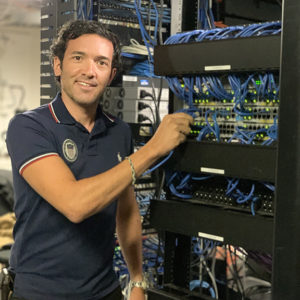
Matthew has 17 years of both public and private sector experience in network administration, application development, disaster recovery, security and strategic planning.