Mobile Application Design and Development
Turn your interest in mobile development into a career needed across a number of different industries.
- Program takes place in a very hands-on, project based environment
- Curriculum is updated annually to ensure what is being taught reflects industry standards
- Provides additional resources for success such as a free online preparation course and program assistants in the first year
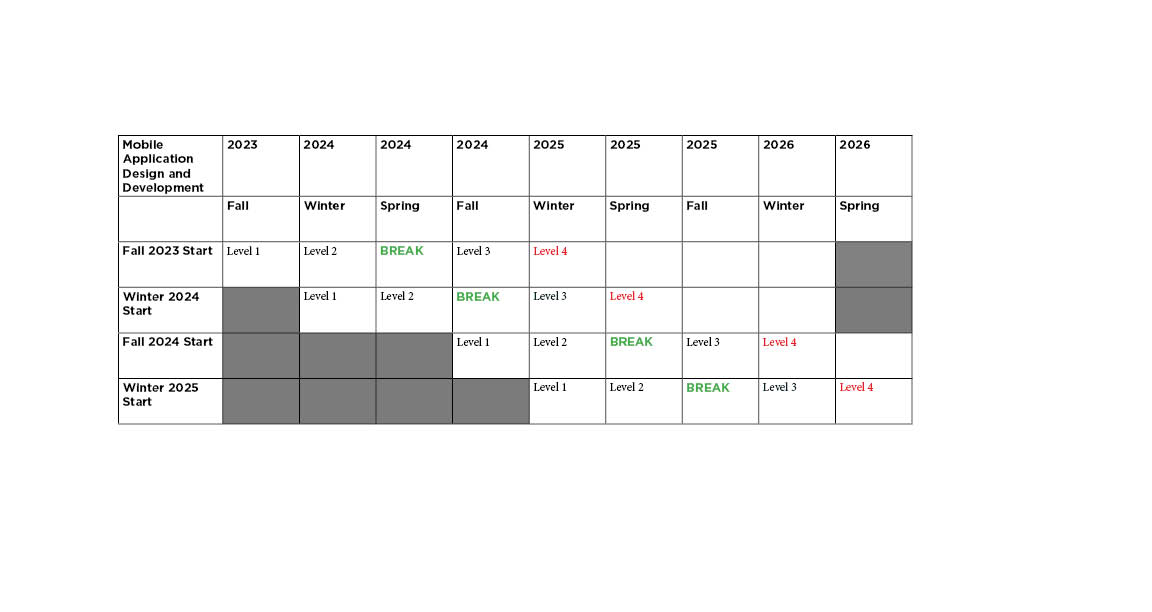
Program Availability and Schedule
Availability
Open
Closed
Waitlisted
Start Term
Availability
International
Availability
Competitive?
Fall 2024
No
Winter 2025
No
Schedule
Program Summary
Credential
Program Delivery
Program Code
Area of Interest
School
Campus
Work Integrated Learning
The two-year Mobile Application Design and Development Ontario College Diploma program prepares you to enter the expanding and evolving fields of mobile web and application development. Design mobile website interfaces across different platforms and devices. Learn how to build native applications for mobile devices and use different technologies and programming languages. Topics covered include:...(read more)
Overview
Turn your interest in mobile development into a career needed across a number of different industries.
The two-year Mobile Application Design and Development Ontario College Diploma program prepares you to enter the expanding and evolving fields of mobile web and application development. Design mobile website interfaces across different platforms and devices. Learn how to build native applications for mobile devices and use different technologies and programming languages. Topics covered include:
- user interface (UI) design
- user experience (UX) design
- responsive web design
- full-stack web development
- hybrid mobile application development
- native mobile application development
- entrepreneurial business skills
Emphasis is placed on a hands-on approach to developing sites and applications.
In your final semester, prepare for industry by developing a mobile solution for a real-world client. Experience working in teams and participate in the analysis, design, implementation, testing and deployment of your mobile solution.
Upon graduation, you may find work in all levels of government, as well as with start-ups and a wide variety of market sectors including technology, healthcare, business, marketing, finance, education and communications. Some available jobs include:
- mobile app developer
- full-stack developer
- UX designer/developer
- web designer
- web developer
- interaction designer/developer
- QA tester
SUCCESS FACTORS
This program is well-suited for students who:
- Are interested in working with computers and mobile devices, such as smartphones and tablets.
- Enjoy the challenge of working with evolving mobile technology.
- Have good problem-solving skills and enjoy solving logic problems.
- Enjoy non-repetitive tasks and the challenge of developing new and creative solutions for mobile applications.
- Can work independently and as a productive member of a team.
- Are organized in their work and pay attention to detail.
- Are committed and dedicated.
- Are proficient with basic computer skills, such as keyboarding and the use of office software suite.
Courses
Programs at Algonquin College are delivered using a variety of instruction modes. Courses may be offered in the classroom or lab, entirely online, or in a hybrid mode which combines classroom sessions with virtual learning activities. Upon registration, each full-time student is provided an Algonquin email account which is used to communicate important information about program or course events.
Code:
MAD8010
Course Name:
Digital Citizenship
Course Description:
Increasingly, students are experiencing online components as part of their course delivery. Blended and online courses require specific skil... + Read More
Hours:
42.0
Code:
MAD9011
Course Name:
Mobile Design Fundamentals
Course Description:
Students are introduced to mobile design fundamentals and graphical user interface design tools. The design concepts include user interface ... + Read More
Hours:
42.0
Code:
MAD9013
Course Name:
Cross-Platform Web Design
Course Description:
Technologies on the web evolve quickly. Every year brings new devices and with them new capabilities. These devices present many challenges ... + Read More
Hours:
56.0
Code:
MAD9014
Course Name:
Cross-Platform Web Development
Course Description:
While developing native applications for mobile devices can hold many advantages, not every application runs only on a phone, and not every ... + Read More
Hours:
70.0
Code:
MAD9112
Course Name:
Essential Tools for Mobile Development
Course Description:
Students explore a diverse set of tools that are used in modern mobile development. They get acquainted with the required MacBook Pro and op... + Read More
Hours:
42.0
Code:
DSN2100M
Course Name:
Design Thinking
Course Description:
Human-centred approaches are among the best methods of generating innovative solutions for people at work, at home or within your community.... + Read More
Hours:
42.0
Code:
ENL1813M
Course Name:
Communications I
Course Description:
Communication remains an essential skill sought by employers, regardless of discipline or field of study. Using a practical, vocation-orient... + Read More
Hours:
42.0
Code:
MAD9020
Course Name:
User Interface Design
Course Description:
Students learn how to create functional, efficient and enjoyable interfaces. They gain an appreciation for the challenges of building websit... + Read More
Hours:
42.0
Code:
MAD9021
Course Name:
Introduction to Object Oriented Programming
Course Description:
Students learn the fundamentals of object-oriented programming within the context of mobile application development. Emphasis is placed on t... + Read More
Hours:
56.0
Code:
MAD9022
Course Name:
Fullstack: Frontend Development
Course Description:
Students build on their web design and development skills through applied practice with modern web development features including Web Compon... + Read More
Hours:
70.0
Code:
MAD9124
Course Name:
Fullstack: API Development
Course Description:
Students extend their JavaScript skills by learning how to develop for the server side. They use a hands-on approach to build secure APIs us... + Read More
Hours:
70.0
Code:
ENL6007
Course Name:
Professional Communication in Digital Media
Course Description:
Strong communication skills are a key part of professional success. Students focus on writing clear, correct and concise print and web-based... + Read More
Hours:
42.0
Code:
MAD9034
Course Name:
User Experience Design
Course Description:
Going beyond the basics of graphics and user interface fundamentals, students learn how to combine these elements to create intuitive, effic... + Read More
Hours:
56.0
Code:
MAD9132
Course Name:
Android Application Development
Course Description:
Students learn to develop mobile applications for the Android mobile platform. Students use the Android application programming interface (A... + Read More
Hours:
70.0
Code:
MAD9135
Course Name:
Multi-Platform Mobile App Development
Course Description:
Students apply their Full-stack web application skills and framework experience, to create mobile applications for multiple platforms using ... + Read More
Hours:
70.0
Code:
MAD9137
Course Name:
IOS Development
Course Description:
Students use the Swift language within the standard Mac OSX development environment to create native applications for the iPhone and iPad. W... + Read More
Hours:
70.0
Code:
MAD9042
Course Name:
Mobile Industry Trends
Course Description:
This course investigates a variety of current topics related to the mobile industry and app development. While the specific course topics ch... + Read More
Hours:
56.0
Code:
MAD9143
Course Name:
Branding and Marketing for the Mobile
Course Description:
The mobile landscape from a brand and marketing point of view is examined. Students learn about core brand elements and marketing strategies... + Read More
Hours:
42.0
Code:
MAD9145
Course Name:
Applied Industry Projects
Course Description:
Working in teams, students experience the analysis, design, implementation, testing and deployment of a mobile solution for a real-world cli... + Read More
Hours:
84.0
Code:
MAD9146
Course Name:
Cross-Platform Native Development
Course Description:
Mobile application development can be accomplished through a variety of languages and frameworks. Students learn how to create cross-platfor... + Read More
Hours:
70.0
Code:
GED1515
Course Name:
General Education Elective
Course Description:
Students choose one course, from a group of general education electives, which meets one of the following four theme requirements: Arts in S... + Read More
Hours:
42.0
Careers & Pathways
Careers
Upon graduation, you may find work in all levels of government, as well as with start-ups and a wide variety of market sectors including technology, healthcare, business, marketing, finance, education, and communications. Some available jobs include: mobile app developer, full-stack developer, UX designer/developer, UX researcher, UI designer/developer, web designer, web developer, interaction designer/developer, QA tester.
Pathways
Please use our Pathways tool to search for pathway options.
Learning Outcomes
The graduate has reliably demonstrated the ability to:
- Identify requirements and implement mobile solutions.
- Promote mobile technology solutions using business communication and marketing skills.
- Create effective user interfaces that leverage evolving mobile device capabilities.
- Design and develop websites that deploy to different devices and platforms.
- Design and develop cross-platform applications built with rich-media and HTML-based technologies.
- Design and develop device-specific, native applications.
- Research and apply various software development kits (SDKs), frameworks and toolkits.
- Integrate database and server-side technologies to provide complete mobile development solutions.
- Build, test, and deploy secure mobile solutions using appropriate network technologies.
- Collaborate in a team-based, mobile development project.
- Identify and apply discipline-specific practices that contribute to the local and global community through social responsibility, economic commitment and environmental stewardship.
Tuition & Fees
Get an idea of how much each semester will cost with our Tuition and Fee Estimator.
2023/2024 Academic Year
Tuition and related ancillary fees for this program can be viewed by using the Tuition and Fees Estimator tool at www.algonquincollege.com/fee-estimator.
Further information on fees can be found by visiting the Registrar`s Office website at www.algonquincollege.com/ro.
Fees are subject to change.
Admissions Requirements
All applicants must satisfy both College Eligibility and Program Eligibility requirements.
College Eligibility
- Ontario Secondary School Diploma (OSSD) or equivalent. Applicants with an OSSD showing senior English and/or Mathematics courses at the Basic Level, or with Workplace or Open courses, will be tested to determine their eligibility for admission; OR
- Academic and Career Entrance (ACE) certificate; OR
- General Educational Development (GED) certificate; OR
- Mature Student status (19 years of age or older and without a high school diploma at the start of the program). Eligibility may be determined by academic achievement testing for which a fee of $50 (subject to change) will be charged.
Program Eligibility
- English, Grade 12 (ENG4C or equivalent).
- Mathematics, Grade 12 (MAP4C or equivalent).
- Applicants with international transcripts must provide proof of the subject-specific requirements noted above and may be required to provide proof of language proficiency. Domestic applicants with international transcripts must be evaluated through the International Credential Assessment Service of Canada (ICAS) or World Education Services (WES).
- IELTS-International English Language Testing Service (Academic) Overall band of 6.0 with a minimum of 5.5 in each band; OR TOEFL-Internet-based (iBT) Overall 80, with a minimum of 20 in each component: Reading 20; Listening 20; Speaking 20; Writing 20; OR Duolingo English Test (DET) Overall 110, minimum of 110 in Literacy and no score below 95.
Not sure if you meet all of the requirements? Academic Upgrading may be able to help with that: https://www.algonquincollege.com/access/.
Should the number of qualified applicants exceed the number of available places, applicants will be selected on the basis of their proficiency in English and mathematics.
Application Information
MOBILE APPLICATION DESIGN AND DEVELOPMENT
Program Code 1515X01FWO
Applications to full-time day programs must be submitted with official transcripts showing completion of the academic admission requirements through:
ontariocolleges.ca
60 Corporate Court
Guelph, Ontario N1G 5J3
1-888-892-2228
Students currently enrolled in an Ontario secondary school should notify their Guidance Office prior to their online application at www.ontariocolleges.ca.
Applications for Fall Term and Winter Term admission received by February 1 will be given equal consideration. Applications received after February 1 will be processed on a first-come, first-served basis as long as places are available.
International applicants please visit this link for application process information: https://algonquincollege.force.com/myACint/.
For further information on the admissions process, contact:
Registrar`s Office
Algonquin College
1385 Woodroffe Ave
Ottawa, ON K2G 1V8
Telephone: 613-727-0002
Toll-free: 1-800-565-4723
TTY: 613-727-7766
Fax: 613-727-7632
Contact: https://www.algonquincollege.com/ro
Additional Information
Program Resources
Although basic computer skills are recommended, programming experience is not a requirement to enter the program.
Contact
Steve Griffith
Program Coordinator
steve.griffith@algonquincollege.com

Steve earned a Bachelor’s Degree in Soviet & East-European Studies from Carleton University in the early 1990s. Shortly after finishing his degree, he began working with a wide variety of client-side and server-side technologies to design and develop web sites and web applications. After a few years working for private IT Colleges, while still consulting with a variety of technology companies, he began teaching at Algonquin in late 2003 in the Interactive Multimedia, Interactive Multimedia Developer, Game Development and Bachelor of Information Technology programs. In 2011, Steve worked with a colleague to create the new Mobile Application Design & Development program to address the lack of training in the rapidly evolving web and mobile technology space. The MAD&D program became the first diploma program of it’s kind in Canada.
Adesh Shah
Program Co-coordinator
Adesh divides his professional time between imparting knowledge to future final-year Mobile Application Design and Development program graduates and being the Principal Investigator for the Data Analytics Research Centre at Algonquin College, researching Machine Learning, Artificial Intelligence, and Big Data. Being a graduate of the same program required Adesh to reflect critically on his pedagogical choices and think deeply about the kind of teacher he wanted to be that would benefit students in the industry. Besides his professional career, Adesh enjoys playing (poorly) and watching basketball, (road) bicycling, hiking, reading extensively, writing, enjoying good food, beer, and perfecting his evil laugh.
Will Paceley
Professor

Will Paceley began his software development career in 2014 when he was tasked with creating a web application to connect local clients seeking musicians with students at the Eastman School of Music.
Building software that helps others is a passion for Will. Professionally, he works as a mobile application developer for the Government of Canada where he develops and maintains large-scale applications that benefit all Canadians. Will has also published multiple native iOS applications to Apple’s App Store that are downloaded daily across the world.
Education is close to Will’s heart. He views teaching as one of the impactful ways to give back to others. Will’s favourite part of teaching is helping students overcome the hurdles that are encountered when transitioning from a beginner programmer to a job-ready developer.
Will holds a Bachelor’s Degree from the Eastman School of Music and proudly received his Diploma in Mobile Application Design and Development here at Algonquin College.
Tony Davidson
Professor

Tony began his career as part of a medical research team at Queens University that developed both the hardware and software for an ultrasound scanner used to measure carotid arterial blood flow. He later moved on to a variety of high level technology positions most notably as the Executive Director of Multimedia at Corel Corporation and CTO of ZIM Corporation.
Tony was responsible for the development and release of over 700 educational, entertainment, mobile and game titles. Most notably he was the original developer and inventor of Corel’s CD Creator, today that product is known as Roxio Creator. Tony was also instrumental in developing Corel’s Internet strategy, including the development of Corel’s Internet commerce server.
Teaching has always been a passion for Tony. He has taught for many years in a variety of College and University programs and for both public and private corporations. He received the Algonquin College Students Association Award for Teaching Excellence in 2009, has been nominated for the Capital Educators Award on three occasions and was also nominated as the “Best Lecturer in Ontario.”
Tony holds a Master’s degree in Education (M.Ed.) from the University of Prince Edward Island.
SuCheng Lee
Professor

SuCheng began her digital product design career in the Supply Chain Management Enterprise Solutions industry. She later moved into data storage security and management, automobile inventory control, and recently, to education and applied research. Her design work appeared widely in various solutions used by McDonald’s, Walmart, Harley Davison, Johnson & Johnson, Kelloggs, Hershey, Hewlett-Packard, just to name a few. She led teams to design solutions that were as big as the virtual reality holo station, to a smartwatch, and a purely no-UI voice-based product.
SuCheng, as an award-winning user experience strategist and architect, is also passionate about innovative research and education. She has been teaching design courses in the School of Media and Design since 2008. Always, her goal in education has been to assist students to gain optimal results in employment upon graduation.
She enjoys mentoring junior UX practitioners; guiding local and international students; collaborating with industry partners to create hands-on learning opportunities for the college; coaching young entrepreneurs; and, leading applied research projects. The success of her students motivates her to be open-minded and continue learning so that she can help the students obtain current and desirable user experience design skills.
Adam Robillard
Professor

Adam Robillard bridges the gap between designer and developer. He is passionate about the entire website development process, from research and competitive analysis, all the way through the design, development and testing. Adam is a graduate of the Graphic Design program at Algonquin College and currently works at Spruce Creative, a digital marketing firm that focuses on working with Indigenous, community, and not-for-profit organizations.